






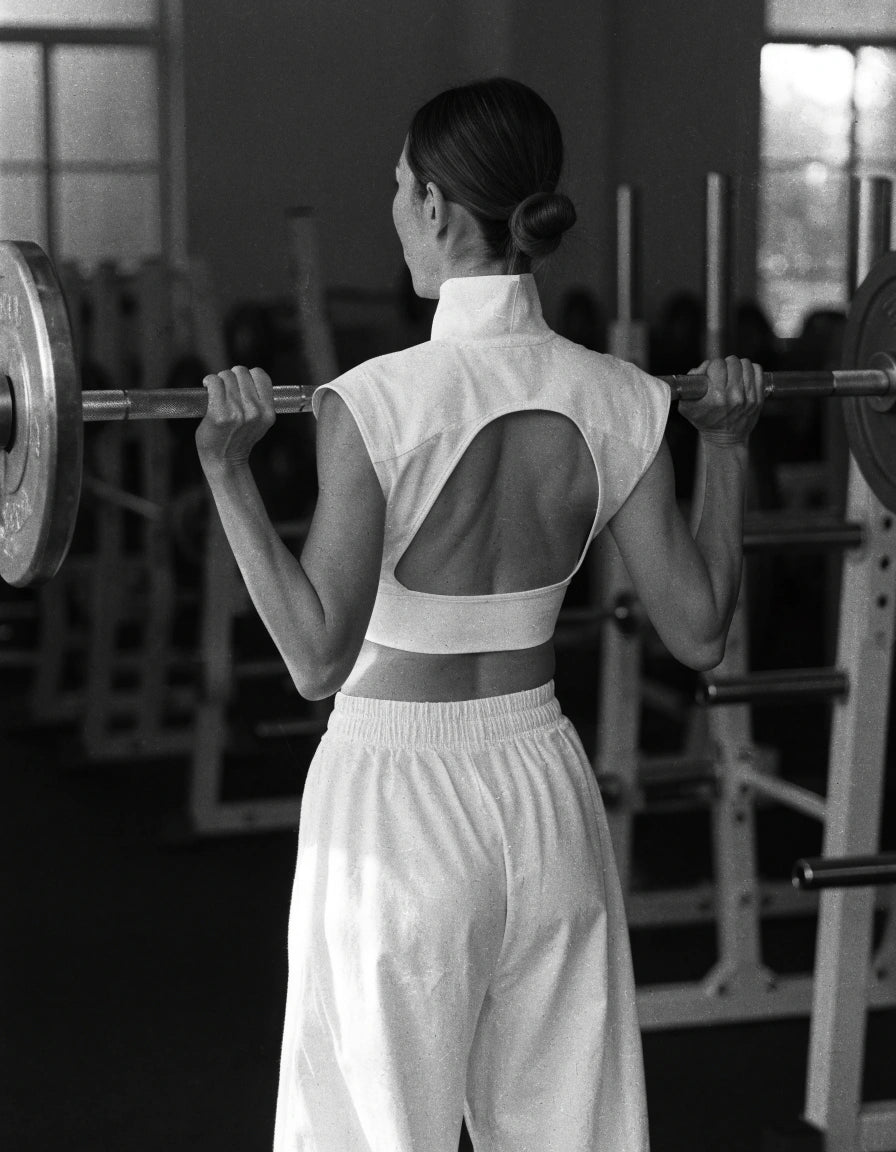
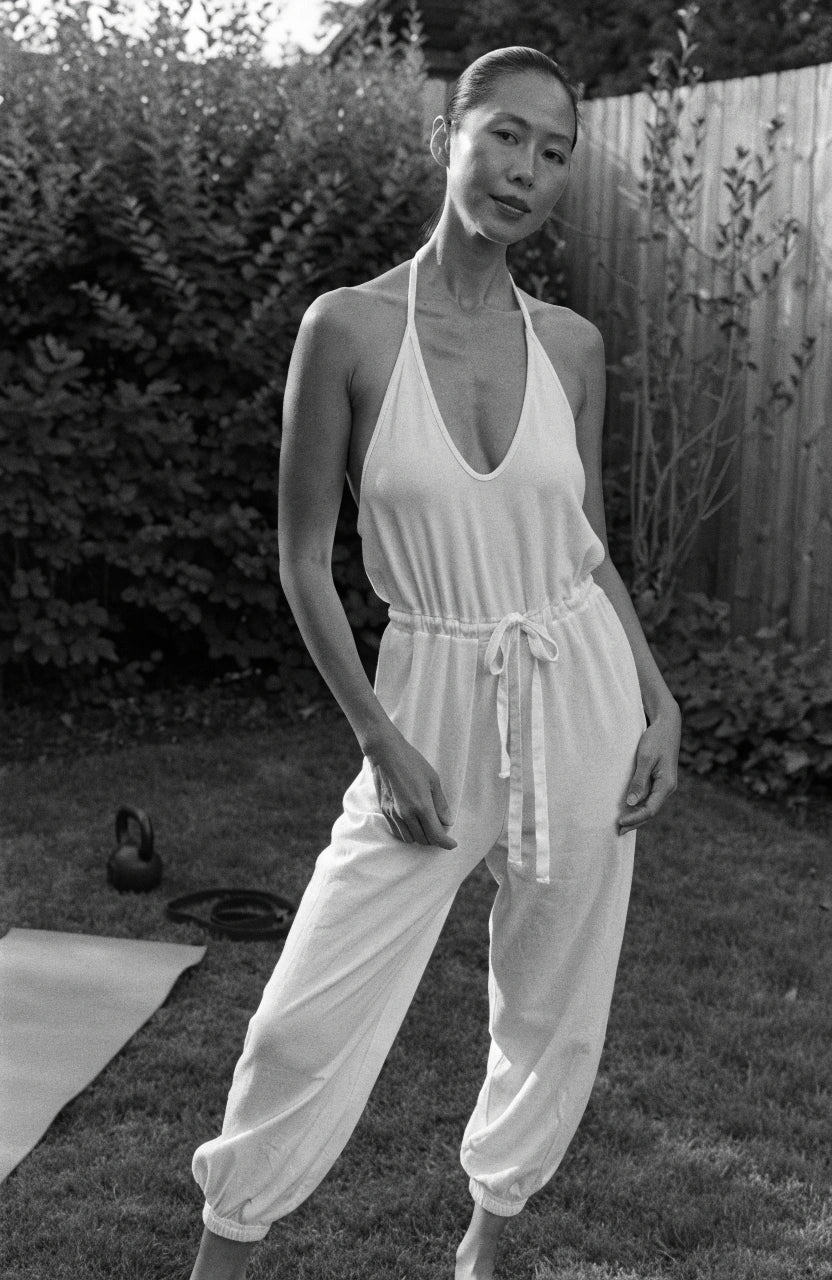
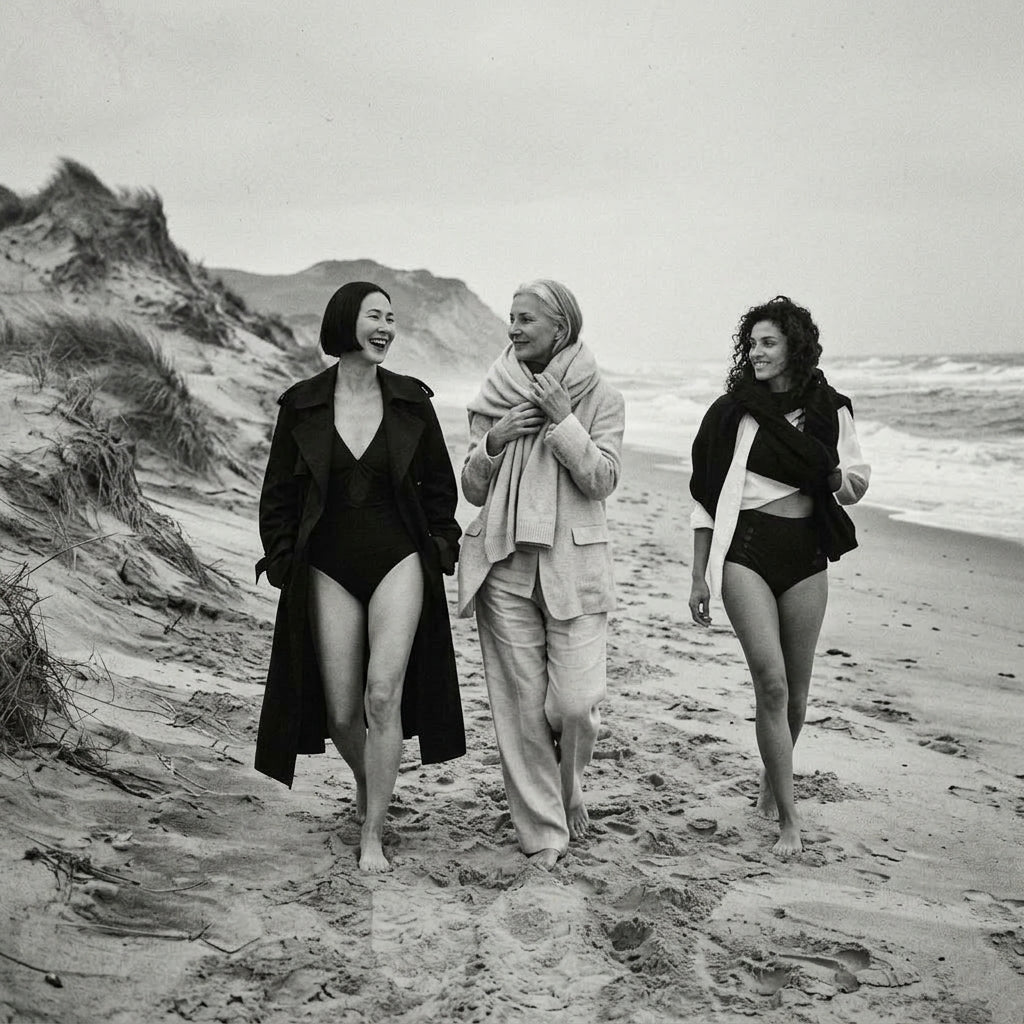
The Female Body
A woman's guide to strength training, sauna and recovery — twenty studies on how the female body works, trains and heals, with the manifq™ pieces made for each one.
Download the guide as a PDFThis guide exists because most training advice is written for a generic body that isn't quite anyone's — and almost never for a woman's. Each study below closes with something to try this week and the manifq™ Spa·Sauna·Steam or Activewear pieces made for it.
Train with the Training Sets. Recover with the Recovery Sets. Read the companion piece, Sauna & Recovery Rituals.
Why bone density is the most important thing you're not training for
Bone is living tissue that rebuilds itself around the loads you give it — and for women, the window to build it is shorter than most realise.
Bone is not inert scaffolding. It remodels continuously, laying down material where stress is highest and withdrawing it where demand is low. For women this carries particular urgency.
- Two strength sessions a week, with loads that feel truly challenging in the last few reps.
- 20–40 small hops or skips, three days a week, on a forgiving surface. Progress only when landings are quiet.
The lymphatic system in heat — why what you wear in the sauna matters
In the heat, circulation rises and the skin becomes the busiest surface of the body. What rests on it deserves the same care as the ritual itself.
The lymphatic system is the body's quiet drainage network — a one-way system of vessels that returns fluid, waste and immune cells from the tissues to the blood. Unlike blood, it has no central pump. Heat changes the conditions around it.
- Shower before you enter — skin free of heavy creams sweats more freely.
- Sit on a clean, natural-fibre pad, never on bare wood or a synthetic towel.
The female shoulder — why rotation matters more than pressing
The shoulder is built to rotate. Training that only pushes in straight lines builds strength in one direction and leaves the rest exposed.
The shoulder is the most mobile joint in the body, and that mobility is bought at the cost of stability. It is held together less by bone than by a layered system of muscle, tendon and connective tissue — above all the small muscles of the rotator cuff. Much conventional programming leans on pressing: pushing load away from the body in straight lines.
- Band external rotations: 2 × 12–15 each side, elbow tucked to your waist.
- Halos with a light weight: 2 × 8 each direction, ribs down, slow.
The fascia your training has been ignoring — and why it holds everything together
Fascia is the body-wide web that connects every muscle. It responds to variety, glide and hydration — not only to load.
Fascia is the connective tissue that wraps every muscle, organ and bone — a continuous web rather than a collection of separate parts. Once cut away in anatomy as packaging, it is now understood as a tensional network that transmits force and helps the body move as one. It responds to more than load.
- Open each session with five minutes of spirals, long reaches and slow lunges in several directions.
- Do mobility when you're warm — after training, a bath or the sauna.
Parasympathetic activation — the science of why stillness is training
Recovery happens in the body's rest-and-repair state. You can't force your way into it, but you can create the conditions.
The autonomic nervous system runs on two branches. The sympathetic prepares the body for effort and threat; the parasympathetic governs rest, digestion and repair. This branch does not switch on by decision.
- Breathe in for 4, out for 6–8, for five minutes.
- After heat, lie down for ten minutes before you reach for your phone.
The pelvic floor — the system most women meet only when it fails
A hammock of muscle at the base of the pelvis that supports, stabilises and breathes with you — best understood long before it becomes a problem.
The pelvic floor is a sling of muscle and connective tissue across the base of the pelvis. It supports the pelvic organs, contributes to continence, stabilises the trunk, and works in coordination with the breath and the deep core. Because it is hidden, it is rarely trained on purpose.
- On your back, knees bent: feel the pelvic floor soften as you inhale and lift gently as you exhale. Ten breaths.
- Exhale as you lift a load — avoid holding your breath and bearing down.
The menstrual cycle as a training map, not a limitation
Your cycle is a recurring shift in physiology. Used as a map — not a rulebook — it helps you read energy, recovery and needs across the month.
The menstrual cycle is often framed as something to manage around training — an inconvenience. A more useful view is that it is a recurring rhythm in physiology, and therefore information. Across a cycle that typically lasts between 21 and 35 days, oestrogen and progesterone rise and fall.
- For three cycles, note: cycle day, energy (1–5), sleep, and how the session felt.
- Place harder sessions on your higher-energy days; keep a recovery-first option ready for the rest.
Why women tear ACLs more often — and what the landing teaches
Women tear the knee's anterior cruciate ligament far more often than men in the same sports. Much of the risk lives in how we land — and landing can be learned.
The anterior cruciate ligament stabilises the knee, controlling how the shin moves relative to the thigh. Female athletes in jumping, cutting and pivoting sports experience ACL injuries at markedly higher rates than male athletes — commonly reported as two to eight times higher, depending on the sport. Several factors contribute: differences in hip and knee alignment, the way force is absorbed on landing, neuromuscular control, and connective tissue that may change with hormonal fluctuations.
- Step off a low box and freeze the landing: knees over toes, hips back, quiet feet.
- Single-leg balance, 30 seconds each side, eyes open, then closed.
The diaphragm and the deep core — how breath builds stability
Your main breathing muscle is also a core stabiliser. Breath and stability are built together, or not at all.
The diaphragm is the primary muscle of breathing, but it is also part of the deep core — the roof of a cylinder whose floor is the pelvic floor, with the deep abdominal and back muscles as its walls. Together these structures manage pressure inside the trunk. When breathing becomes shallow and chest-led — through stress, long hours at a desk or habitual bracing — this system loses its coordination.
- Hands around your lower ribs: breathe so they widen sideways and into your back, not just up.
- Before a lift, breathe in to fill; breathe out steadily through the hardest part.
Rotational power — the capacity most training leaves undeveloped
Life twists, turns and throws. Most training moves forwards and backwards. Rotation is the capacity most women never develop.
Most training happens in straight lines — up and down, forward and back. But life moves in rotation: turning to reach behind you, throwing, carrying a child on one hip, catching yourself when you slip. Rotational power is produced through the whole body.
- Half-kneeling band chops: 2 × 10 each side.
- Suitcase carry: one weight, one hand, walk tall for 30 metres, then switch.
Heat as a stressor — the science of deliberate thermal practice
Deliberate heat is a short, controlled stress the body learns to adapt to — the same principle as training, in a different form.
Heat exposure is a stressor, and like every useful stressor it asks the body to respond. In a sauna, core temperature rises, heart rate climbs, blood vessels near the skin dilate and sweating begins. Large observational studies, most of them from Finland, link regular sauna bathing with better cardiovascular health and longer life.
- Start with 8–10 minutes at a comfortable heat and build gradually.
- Leave the moment you feel dizzy, nauseous or unwell — the ritual is never about endurance.
The skin in heat — the body's largest organ, at its busiest when warm
Your skin is your largest organ. In the heat it is flushed, sweating and in constant contact with what you wear.
Skin is the body's largest organ and its primary barrier — an interface that regulates temperature, manages moisture, senses touch and protects against the outside world. Heat changes how it behaves.
- Remove make-up before the sauna and let skin sweat freely.
- Pat, don't rub, with a soft cotton towel after your rinse.
Impact, load, and the bone you build before you need it
Bone builds in response to specific signals. The skeleton you rely on later is the one you load now.
Bone responds to specific signals, and not all activity strengthens it equally. It is most stimulated by forces that are high relative to what it is used to, applied quickly, and varied in direction. Timing matters across a woman's life.
- Progress your loads every few weeks: squats, deadlifts, step-ups, presses.
- Hop in different directions — forwards, sideways, backwards.
Cortisol, stress, and why recovery is a hormonal skill
Recovery is not passive. Bringing the stress hormone cortisol back down is a skill — and it decides how much of your training becomes progress.
Cortisol is a stress hormone with a legitimate and useful role. It mobilises energy, sharpens focus and helps the body meet demand. Training raises cortisol by design.
- When life stress is high, lower training intensity rather than adding more.
- Protect one screen-free hour before bed.
Circulation, the silent engine of recovery
Recovery is a delivery problem: oxygen and nutrients in, waste out. Circulation is the engine that does the work.
Circulation delivers what tissue needs to repair — oxygen, nutrients, hormones — and carries away what it no longer needs. At its most basic, recovery is a delivery problem, and circulation is the engine. Movement is the primary driver.
- On rest days: 20–30 minutes of easy walking.
- Contrast: heat, a cool rinse, then rest — two or three rounds.
Coordination before load — why the nervous system learns first
Strength is not only a property of muscle. The nervous system learns the pattern first — and that is where training should start.
Before a muscle grows, the nervous system adapts. In the first weeks of a new movement, much of the improvement comes from better coordination: the brain recruiting the right muscles, in the right order, with the right timing. This has a clear practical consequence.
- Learn new lifts with a slow, three-second lowering phase.
- Hold a wall for single-leg work before you add weight.
Sleep — the training session you don't feel
The work is done in the gym or the studio. The change happens while you sleep.
Sleep is not the absence of activity. It is an active, structured process during which the body repairs tissue, consolidates learning, releases growth-related hormones and resets the nervous system. That makes sleep the training session you never feel.
- Wake at the same time every day, weekends included.
- Heat 1–2 hours before bed, then a cool, dark room.
Fuel, energy availability, and training the female body well
You cannot build on an empty tank. Enough energy is the precondition for every adaptation training is meant to produce.
Training demands energy, and the body must have enough of it — not only to perform, but to recover, adapt and maintain the systems that keep it healthy. Energy availability is what remains for those functions once training has been paid for. The female body is particularly sensitive here.
- Eat a meal or snack with protein and carbohydrate within a few hours of training.
- Include a source of protein at every meal.
Strength across the decades — building for the body you'll have
Muscle, bone and balance all change with age — and all respond to training at any age. Build for the body you'll live in.
The body changes across the decades, and some of those changes are not optional. Muscle mass tends to decline with age, faster if nothing is done about it. For women, perimenopause and menopause sharpen these shifts.
- Strength train at least two days a week — the World Health Organization's guidance for adults of every age.
- Add balance: stand on one leg while you brush your teeth.
The body as one system — why nothing here stands alone
We divide the body into systems to understand it. The body itself makes no such division.
It is convenient to divide the body into systems — skeletal, lymphatic, nervous, endocrine — and this guide has done exactly that. But the division is a tool for understanding, not a description of reality. Fascia connects the muscles.
- Each week, plan both halves: at least two strength sessions and at least two deliberate recovery sessions.
- Check in once a week: sleep, energy, cycle, mood, soreness.
Questions women ask about training, the sauna and recovery.
What should women wear in a sauna?
Something light, loose and made from breathable natural fibre — or nothing at all where that is the custom. Cotton gauze, for example, lets sweat evaporate and stays soft against warm skin, while synthetic fabrics trap heat and moisture. Sit on a natural-fibre pad or towel rather than bare wood, and wrap your hair to protect it from the heat.
Is it safe to use a sauna during your period?
For most women, yes. Some find warmth eases cramps; others feel light-headed or more tired, so shorten the session and drink more water. Use whatever period product you are comfortable with, and leave if you feel unwell.
Can I use a sauna when pregnant or trying to conceive?
Speak to your doctor or midwife first. Raising core body temperature is a particular concern in early pregnancy, so most guidance advises caution or avoidance.
How often should women strength train?
The World Health Organization recommends muscle-strengthening activity on two or more days a week for adults, alongside regular aerobic activity. Consistency over months matters more than any single session.
Does training with your menstrual cycle work?
The research is still mixed and individual differences are large. The most reliable approach is to track how you feel across two or three cycles and adjust intensity and recovery to your own pattern, rather than follow a fixed template.
Why organic cotton for activewear?
Cotton is breathable, soft against the skin and free of the plastic feel of fully synthetic fabric. A small amount of elastane gives it the stretch and recovery training needs. The manifq™ training pieces are made from organic cotton with elastane, in the spirit of the honest studio wear of the 70s to 90s.
How long should I stay in the sauna?
Start with 8–10 minutes and build gradually; many people settle at 10–15 minutes per round, for two or three rounds, with a cool-down and rest between. Leave immediately if you feel dizzy, nauseous or unwell.
Is it too late to start strength training after 40 or 50?
No. Muscle and bone respond to training at every age, and perimenopause is one of the most valuable times to begin. Start with technique and moderate loads, progress steadily, and get guidance if you have a health condition.
Why is bone density so important for women?
Women reach peak bone mass around thirty and lose bone faster around menopause as oestrogen falls, which raises the risk of osteoporosis and fractures later in life. Strength training and impact — hopping, skipping, landing — are the most effective ways to build and protect bone at every age.
How do I train my pelvic floor?
Start with breath: feel the pelvic floor soften as you breathe in and lift gently as you breathe out. Practise relaxing as well as lifting, and breathe out as you lift heavy things. If you have leaking, heaviness or pain, a pelvic health physiotherapist can assess you and guide the right exercises.
Will lifting weights make me bulky?
For most women, no. Building large muscles takes years of very specific training and eating. What strength training reliably builds is strength, bone density, better posture and more resilience — the qualities that matter most across a lifetime.
What is the best way to recover after training?
Sleep, enough food, water and gentle movement come first. Beyond that, practices that calm the nervous system — slow breathing, warmth such as a sauna, a cool rinse and quiet rest — help the body shift from effort into repair. Recovery is part of training, not a break from it.

Receive our monthly observations
Essays, anatomy, movement, and thoughtful releases. By signing up, you agree with our privacy policy.